Love Bombing Meaning


Introduction
Love bombing is a manipulation pattern in which a person overwhelms another with excessive attention, affection, compliments, and gifts very early in a relationship to gain emotional control. It feels like intense, instant love, but the behavior is unsustainable and often shifts to withdrawal once the partner becomes emotionally dependent.
That short definition captures the meaning of love bombing, but the full picture is more nuanced. Love bombing is a pattern in which a person overwhelms another with excessive attention, affection, compliments, and emotional intensity early in a relationship.
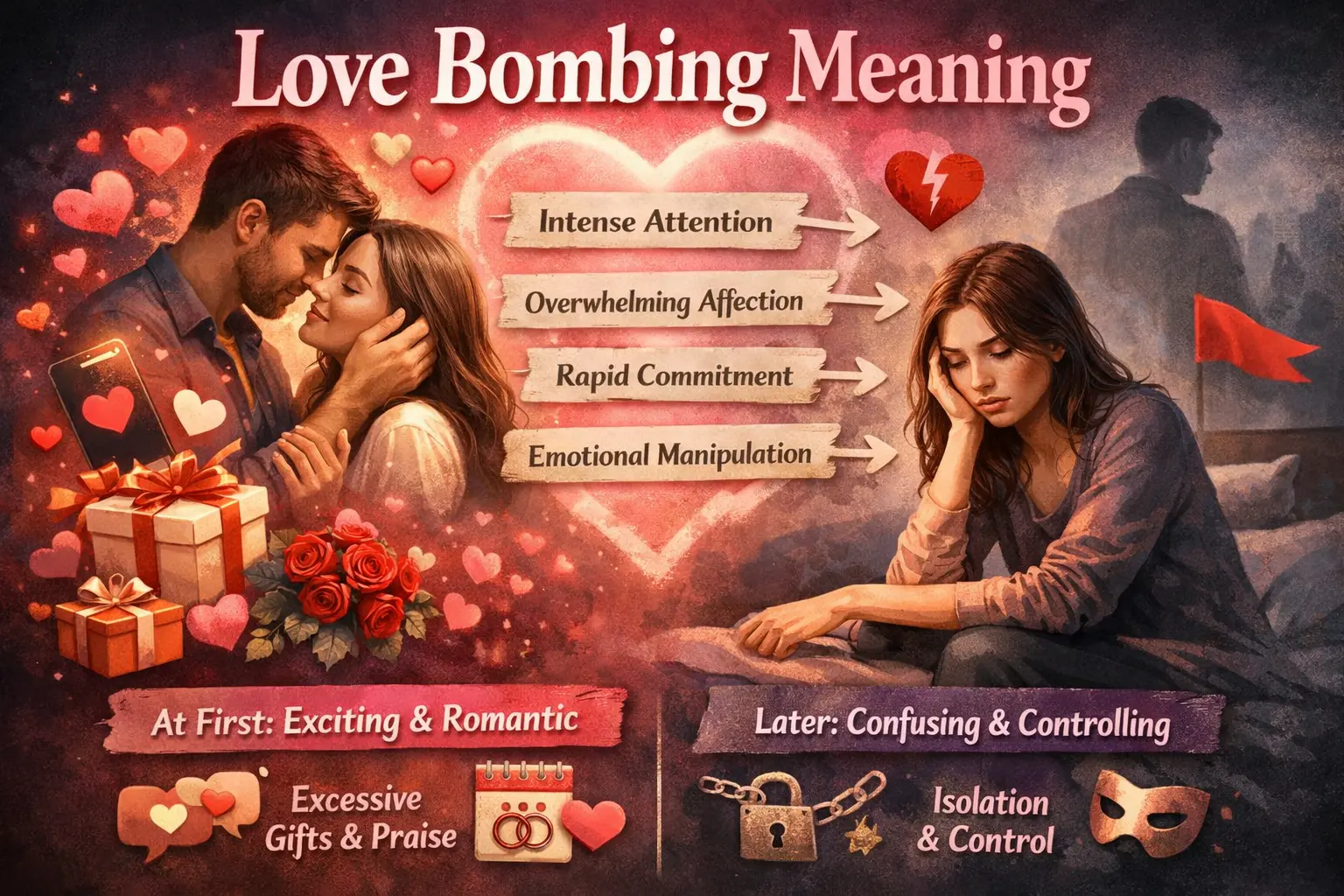
At first glance, this behavior may feel exciting, validating, and deeply romantic — yet beneath the surface it can signal imbalance, emotional dependency, or attempts to influence and control a partner. Understanding love bombing is crucial in modern dating, especially online, where relationships can escalate within days, and a flood of compliments and gifts can blur your judgment. This guide covers the psychological foundations, behavioral patterns, emotional effects, stages, real examples, red flags, and practical steps for responding.
[block:ladies]
What Is Love Bombing?
Love bombing is a relational behavior characterized by excessive displays of affection and attention that occur early in a relationship. The term originally described high-pressure recruitment tactics, but today it most often describes a partner who showers you with love so quickly that you cannot evaluate the relationship clearly.
Key characteristics include frequent messaging, constant reassurance, grand gestures, lavish gifts, and rapid emotional escalation. Unlike genuine affection, love bombing accelerates emotional closeness before trust and shared experience have time to establish themselves. For many people, the behavior functions as an attachment mechanism: once dependency forms, the same partner who was endlessly attentive may suddenly become inconsistent, reduce contact, or withdraw emotionally — a shift that defines the love bombing cycle.
Love Bombing Examples
Concrete examples make the meaning of love bombing easier to recognize. Common examples include:
A new partner texts and calls all day, every day, and expects an immediate reply each time.
Someone says "you're my soulmate" or "I've never felt this way before" within the first week.
Expensive gifts, flowers, or trips arrive before you have even met in person or had a second date.
A person pushes to make the relationship exclusive, move in together, or plan a future after only a few conversations.
Compliments feel exaggerated or scripted — you are "perfect," "flawless," "the one" — long before they could truly know you.
Any attempt to slow down or set boundaries is met with guilt, sulking, or accusations of not caring.
Key Characteristics of Love Bombing Behavior
Excessive Attention and Constant Communication
A person may communicate frequently throughout the day, expecting immediate replies and maintaining continuous engagement. This creates a sense of pressure and emotional dependency.
Intense Compliments and Idealization
Early and exaggerated praise is common. Statements suggesting that someone is "perfect" or "the one" may appear before the relationship has had time to develop naturally. The volume of compliments is part of the signal — genuine partners praise specific, real qualities rather than offering constant, sweeping flattery.
Rapid Escalation of Commitment
There may be pressure to define the relationship quickly, discuss long-term plans early, or establish exclusivity before emotional compatibility is fully understood.
Overwhelming Emotional Expression
Frequent declarations of love or deep emotional attachment can occur within a very short time frame, creating an imbalance in emotional pacing.
Boundary Challenges
Personal boundaries may be overlooked or subtly pushed. The person may expect constant availability or discourage independent time and space with friends and family.
Lavish Gifts and Grand Gestures
Expensive gifts, surprise gestures, and over-the-top romantic displays are a frequent sign of love bombing. The gifts are not the problem in themselves — the warning sign is when they arrive too fast, feel disproportionate to the stage of the relationship, or come with an unspoken expectation of commitment or compliance in return.
Psychological Foundations Behind Love Bombing
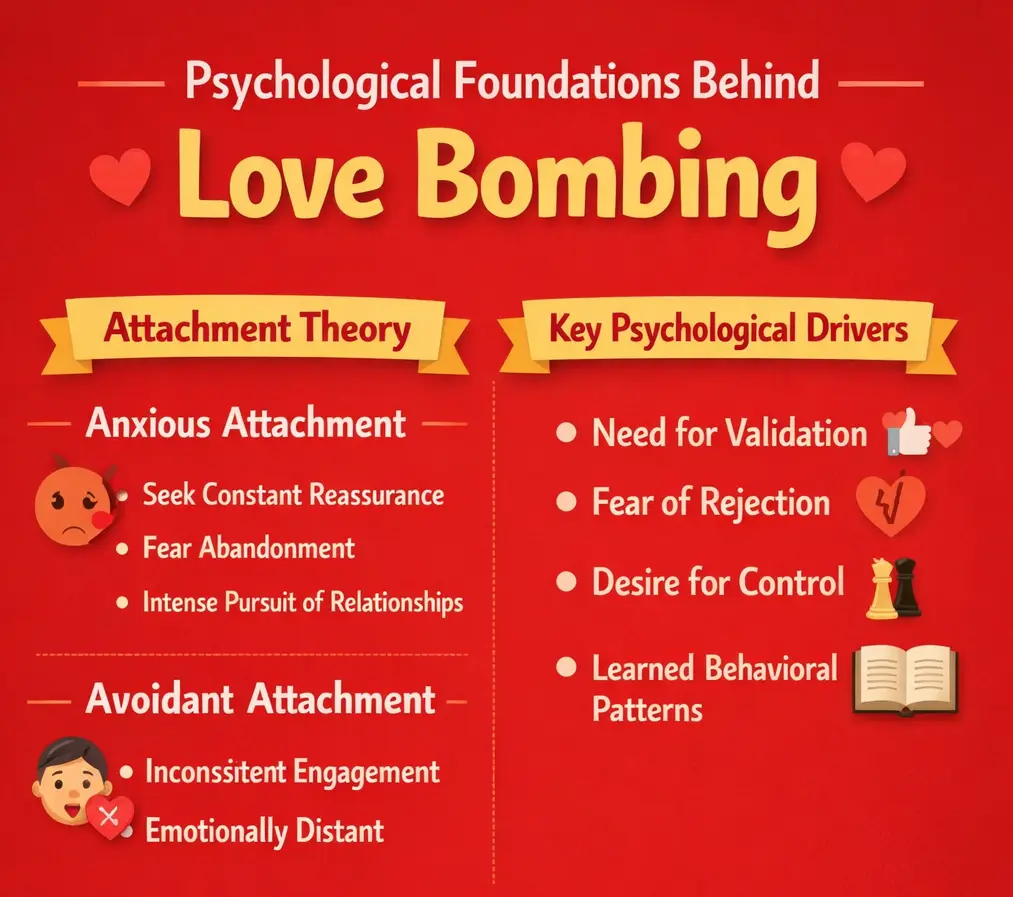
The behavior behind love bombing can be better understood through psychological frameworks such as Attachment theory. This theory explains how early life experiences influence adult relationship patterns.
Individuals with anxious attachment styles may:
Seek constant reassurance
Fear abandonment
Attempt to secure relationships quickly through intensity
Avoidant individuals, on the other hand, may display inconsistent engagement, which, when combined with intense early attachment behaviors, contributes to unstable relational dynamics.
Additional psychological drivers include a strong need for validation, fear of rejection, a desire for control, and learned patterns from past relationships. Love bombing may also overlap with manipulative behaviors such as gaslighting and coercive control, although these concepts remain distinct from one another.
Why Love Bombing Feels So Intense
Love bombing often triggers strong emotional responses due to the level of attention and validation involved. The recipient may feel uniquely valued, understood, and desired.
This intensity can activate brain reward systems, reinforcing positive emotions and creating a psychological association between the person and feelings of happiness or excitement. As a result, it may become difficult to objectively evaluate the relationship. The emotional high created in the early stages can obscure potential imbalances, making the relationship appear more meaningful than it has yet become.
Stages of Love Bombing in Relationships
Idealization Stage
The individual is placed on a pedestal and treated as exceptionally special. The interaction feels highly positive and emotionally charged.
Intensification Stage
Communication increases, emotional closeness deepens, and expectations begin to form. The relationship progresses rapidly.
Dependency Formation Stage
Emotional attachment strengthens, and one partner may begin to rely on the intensity of attention and validation received.
Shift or Withdrawal Stage
In some cases, the behavior changes. Attention may decrease, communication may become inconsistent, or emotional distance may emerge, creating confusion. This is the point where many people first sense the love bombing cycle — and where the early flood of affection is revealed as conditional rather than stable.
Is Love Bombing Abuse?
Love bombing is not always abuse, but it can be the opening phase of an emotionally abusive relationship. When the pattern is used deliberately to gain control over a partner, it functions as a form of emotional abuse — and in some relationships it precedes coercive control, manipulation, or even domestic violence.
A common abusive cycle looks like this: intense love bombing, followed by devaluation or criticism, followed by withdrawal, followed by renewed affection to pull the partner back in. This repeating cycle keeps the recipient focused on regaining the original intensity rather than on whether the relationship is healthy. Not every instance of love bombing is intentional or abusive — sometimes it reflects an insecure attachment style rather than a desire to control — but persistent boundary violations, isolation from friends and family, and pressure to comply are serious red flags that the behavior has crossed into abuse.
Emotional and Psychological Effects
Love bombing can have a significant impact on emotional well-being:
Confusion about the authenticity of feelings.
Emotional dependency on external validation.
Difficulty maintaining personal boundaries.
Anxiety when attention decreases.
Reduced self-trust or clarity.
These effects may influence how individuals approach not only the current relationship but also future ones.
Love Bombing vs Genuine Affection
Genuine affection | Love bombing |
|---|---|
Develops gradually | Escalates quickly |
Respects boundaries | May ignore boundaries |
Maintains consistent behavior | Creates emotional pressure |
Encourages independence | Relies on intensity rather than consistency |
Builds trust over time | Can lead to imbalance or dependency |
While both may initially feel positive, the underlying patterns differ significantly. The clearest test is time: genuine affection stays consistent as weeks pass, while love bombing tends to fade or fluctuate once the partner is emotionally invested.
Analytical Perspective on Relationship Dynamics
Love bombing disrupts the natural balance of a relationship. Healthy relationships feature mutual emotional investment and shared pacing, whereas love bombing creates an asymmetry in which one person invests intensely while the other becomes the focal point of attention. This imbalance can shift relational power dynamics, leading to:
This imbalance can shift relational power dynamics, leading to:
Increased emotional dependency
Reduced autonomy
Skewed decision-making influenced by intensity rather than compatibility
Over time, this dynamic may either stabilize, cycle between extremes, or dissolve entirely, depending on how both individuals respond.
Behavioral Psychology and Reinforcement Cycles
Behavioral psychology suggests that love bombing may operate through reinforcement mechanisms. The recipient receives high levels of positive reinforcement early on, which strengthens emotional attachment.
This can create a cycle where:
Intense affection is provided
Emotional attachment forms
Attention may later fluctuate
The recipient seeks to regain the initial intensity
This pattern resembles intermittent reinforcement, which is known to strengthen behavioral attachment because of its unpredictability.
Cognitive Biases in Love Bombing Experiences
Halo Effect: Early positive impressions overshadow potential concerns
Confirmation Bias: Selectively focusing on positive signals that confirm emotional beliefs
Emotional Reasoning: Interpreting strong feelings as proof of compatibility
These biases can make objective assessment of relationships and early recognition of warning signs more difficult.
Emotional Dependency and Autonomy
One significant risk of love bombing is the development of emotional dependency. When people become accustomed to constant validation and attention, their emotional stability may come to rely heavily on the other person.
This can affect autonomy by:
Reducing independent decision-making.
Increasing reliance on external validation.
Limiting personal boundaries.
Creating hesitation in expressing disagreement.
Maintaining independence is essential to preserving a balanced emotional state within any relationship.
Insights from Surveys and Behavioral Observations
While direct global statistics specifically focused on love bombing are limited, related research in relationship psychology and behavioral studies provides useful insights:
Relationships that develop too quickly tend to have lower long-term stability
Individuals with anxious attachment styles are more responsive to intense emotional signals
High initial intensity may create a perception of closeness that is not yet supported by shared experience
In online dating environments, frequent communication can accelerate perceived intimacy
These observations suggest that pacing plays a crucial role in relationship sustainability.
Red Flags and Common Warning Signs
The red flags of love bombing tend to appear early and cluster together. Watch for these signs:
Rapid emotional escalation within a short time
Overwhelming communication patterns
Pressure to commit early
Excessive compliments that feel unrealistic
Discomfort or emotional overload
Resistance to slowing the relationship down
Lavish gifts that feel disproportionate to the stage of the relationship
Attempts to isolate you from friends and family
Guilt or anger when you set a boundary
Recognizing these red flags early can help maintain clarity and prevent emotional imbalance.
How to Respond to Love Bombing
Set Boundaries
Clearly communicate your comfort level regarding communication, pace, and emotional involvement.
Slow the Relationship Down
Allow time for natural development rather than following the other person's intensity.
Observe Consistency
Pay attention to whether behavior remains stable when boundaries are introduced. A partner who respects your pace is a good sign; one whose attention or mood changes the moment you slow down is showing you the pattern.
Maintain Independence
Continue engaging in personal interests, social connections, and routines.
Seek External Perspective
Trusted friends or advisors can provide objective insights that help evaluate the situation more clearly.
Where to Get Help
If love bombing has shifted into control, isolation, or abuse, support is available. A licensed therapist or counselor can help you understand the pattern and rebuild emotional autonomy, and many regions offer free, confidential domestic-violence and relationship-support services and helplines. Talking to trusted friends and family is also a valuable first step — an outside perspective often makes a pattern visible that is hard to see from inside the relationship.
Long-Term Relationship Outcomes
Relationships influenced by love bombing may follow different trajectories:
Stabilization: Both partners adjust and establish a balanced dynamic
Cyclical Pattern: Alternating phases of intensity and withdrawal
Dissolution: The relationship ends due to imbalance or incompatibility
The outcome often depends on awareness, communication, and willingness to adapt behavior.
Find Genuine Relationships with LuluDate
If you are looking for meaningful connections that can lead to long-term commitment or even marriage, LuluDate is designed to help you move beyond superficial interactions and focus on real compatibility.
LuluDate is built around the idea of connecting people who are genuinely interested in building serious relationships. The platform emphasizes authenticity, structured communication, and culturally meaningful connections, making it easier to meet individuals who share similar intentions and relationship goals.
Why Choose LuluDate?
Verified Profiles: All profiles are checked to ensure authenticity, reducing the risk of fake accounts and increasing trust in interactions.
Serious Relationship Focus: The platform is geared toward users interested in meaningful relationships rather than casual or short-term communication.
Cultural Connection Opportunities: LuluDate allows users to explore relationships across different cultures, helping build a deeper understanding and compatibility.
User-Friendly Communication Tools: The platform provides modern communication features that make it easy to connect, interact, and maintain conversations.
Curated Environment: The community is structured to encourage respectful, intentional, and goal-oriented interactions.
Global Reach: You can connect with people from around the world, expanding your opportunities to find someone who truly matches your expectations.
Choosing LuluDate means meeting like-minded individuals who share long-term relationship intentions — and building trust at a healthy pace, away from the pressure and red flags of love bombing.
[block_inline:info_card]
Conclusion
Understanding love bombing provides valuable insight into how intense emotional behavior shapes relationships. While initial excitement and affection are natural, excessive intensity without balance can lead to confusion, dependency, and emotional instability. The key takeaways are to recognize behavioral patterns, understand the psychological foundations, watch for red flags, and maintain healthy boundaries to make informed relationship decisions. Long-term success lies not in intensity alone, but in consistency, mutual respect, and gradual emotional development.