Online Dating Scams: How to Spot a Dating Scammer, Fake Photos and Romance Fraud


Introduction
Online dating makes it easier to meet people outside your usual social circle. But the same technology can also be used to create fake identities, build trust, manipulate emotions, and steal money.
Online dating scams now go beyond simple fake profiles. Romance fraud can involve investment scams, sextortion, catfishing, fake dating websites, cryptocurrency schemes, and AI-generated identities. The FBI also warns that criminals are using AI to create convincing profiles and personalized conversations at scale.
So how do online dating scams work, what are the most common types, and how can you recognize a scammer before you lose money or personal information?
[block:ladies]
What Is an Online Dating Scam?
An online dating scam is a form of fraud in which someone creates a deceptive relationship through a dating site, app, social media, or another online service.
The scammer usually tries to:
build emotional trust;
collect personal information;
move the conversation away from the dating platform;
obtain intimate photos;
introduce an investment opportunity;
eventually ask for money, cryptocurrency, or other valuables.
The important point is that the relationship itself becomes part of the deception. Romance scammers often spend weeks or months building trust before making a financial request.
How Do Online Dating Scams Work?
Most scams follow a recognizable pattern, although the details can vary.
1. A convincing profile
The scammer may use:
stolen photographs;
AI-generated images;
copied personal information;
fake occupations;
false locations;
invented relationship histories.
The goal is to create a profile that looks believable rather than obviously fake.
2. Building trust
The conversation usually starts normally. The person may ask about your interests, work, family, lifestyle, and plans. Over time, they may become increasingly attentive and emotionally involved.
3. Moving off the dating platform
A scammer may quickly suggest switching to WhatsApp, Telegram, email, or another private messenger.
Moving platforms is not proof of fraud. The warning sign is when someone pushes for private communication unusually quickly or tries to avoid the dating site's safety features. The FBI and FTC both identify this behavior as a common pattern.
4. Emotional grooming
The relationship becomes more intense.
The person may talk about a future together, describe a strong connection, or make you feel that the relationship is unusually special.
This emotional investment can make later requests seem more believable.
5. The request
Eventually, the story may involve:
a medical emergency;
travel expenses;
visa or immigration problems;
family difficulties;
cryptocurrency;
an investment;
unexpected debt.
The FTC warns that romance scammers commonly use urgent stories and may direct victims toward cryptocurrency or other hard-to-recover payment methods.
How to Spot a Dating Scammer
There is no single sign that proves someone is a scammer. Look for combinations of warning signs.
They become emotionally intense very quickly
Be cautious when someone you barely know starts talking about marriage, soulmates, children, or a shared future.
Fast emotional intimacy alone does not prove fraud, but it becomes more concerning when combined with other warning signs.
They always have a reason not to meet
A scammer may claim to be:
working overseas;
in the military;
working on an oil rig;
traveling for business;
dealing with an emergency.
Repeatedly canceling plans to meet is a common romance-scam pattern.
Their story keeps changing
Check whether their age, location, occupation, family situation, or travel history remains consistent.
One mistake is not proof of fraud. Multiple contradictions are more significant.
They try to isolate you
A scammer may discourage you from discussing the relationship with friends or family.
This makes it easier to maintain the deception and harder for someone else to notice inconsistencies.
They ask for money
This is one of the clearest warning signs.ьBe especially careful if someone you have never met asks you to:
transfer money;
send cryptocurrency;
buy gift cards;
pay their bills;
pay travel expenses;
receive or transfer money for them.
The FTC's basic advice is simple: never send money or gifts to an online love interest you have never met in person.
Fake Dating Profile Photos: How to Check Them
A profile photograph can look completely realistic and still belong to someone else or be artificially generated.
Reverse image search
Run the profile photo through a reverse image search.
You may find the same image:
under another name;
on several dating profiles;
on social media;
on a stock-photo website;
on a modeling website.
The FTC specifically recommends reverse image searching a suspicious dating profile photo.
Compare the whole profile
Don't examine the photograph alone.
Compare it with the person's:
age;
location;
occupation;
lifestyle;
other photographs;
relationship story.
AI-generated images are becoming harder to identify through visual clues alone. The FBI says AI can now be used to create convincing synthetic profiles and personalized conversations, making independent identity verification increasingly important.
The Most Common Online Dating Scams
1. Emergency Romance Scams
The scammer invents an urgent problem and asks for immediate help.
Common stories include:
hospital bills;
travel problems;
lost documents;
legal issues;
family emergencies.
The emotional connection is used to make the request feel personal and urgent.
2. Investment Romance Scams
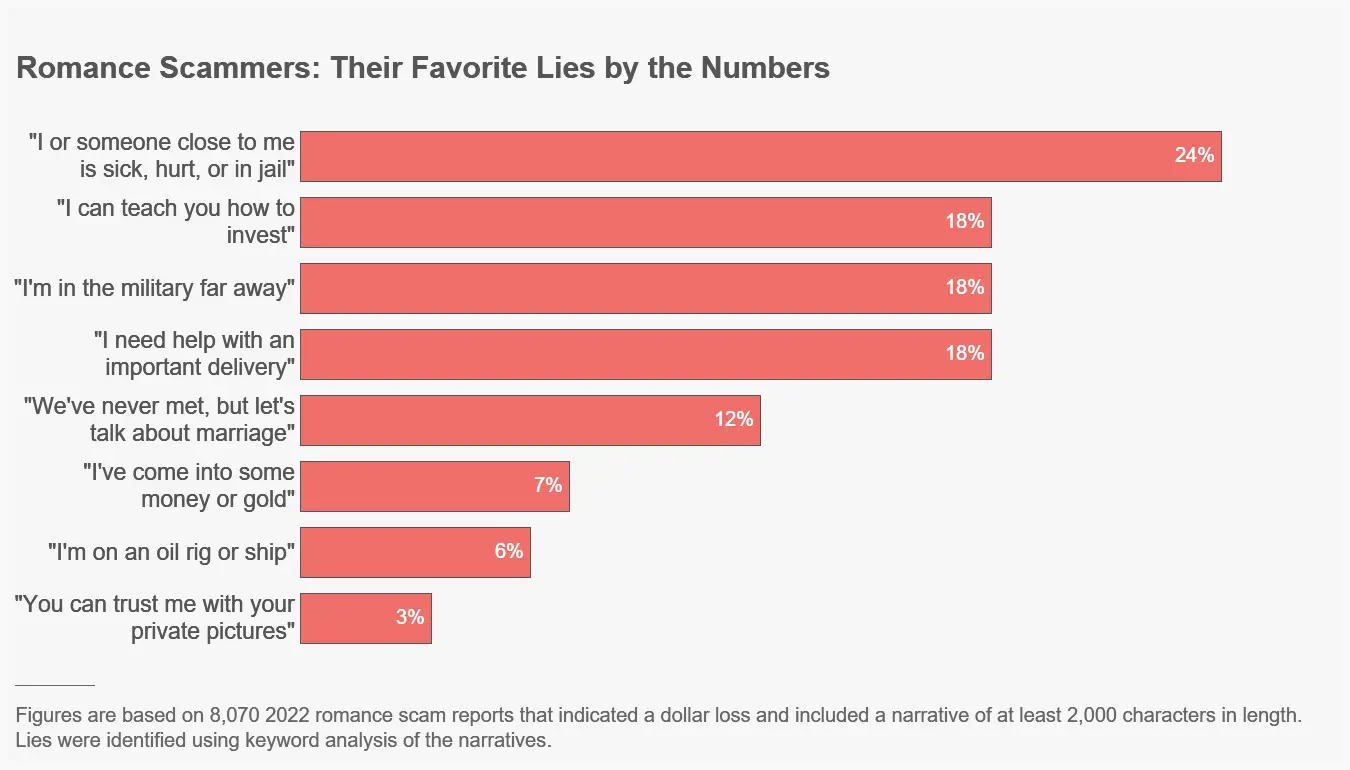
The scammer presents themselves as financially successful or knowledgeable about investing.
After building trust, they introduce the victim to cryptocurrency, forex, or another investment opportunity.
The victim may see fake profits on a fraudulent platform and then be asked to pay additional fees before withdrawing the money. The FBI and CFTC both warn about romance scams that develop into cryptocurrency investment fraud.
3. Sextortion
The scammer encourages the victim to send intimate photographs or videos.
They then threaten to share the material with friends, family, colleagues, or publicly unless the victim pays.
4. Catfishing
Catfishing involves creating a false identity online.
Someone may lie about their:
appearance;
age;
occupation;
location;
relationship status.
Catfishing becomes a scam when the false identity is used for exploitation, fraud, or financial gain.
5. Fake Dating Websites
The scam does not always come from another user.
A fraudulent dating website may use:
fabricated profiles;
fake messages;
fake matches;
unclear pricing;
misleading communication systems.
This is why users should evaluate the dating platform itself, not just the people they meet on it.
6. AI Dating Scams
AI is making online deception easier to scale. Criminals can use AI to create profile photos, write biographies, generate messages, translate conversations, and maintain personalized interactions.
The FBI reported more than 22,000 AI-related complaints in 2025, with reported losses exceeding $893 million. It also identified AI-enabled confidence and romance scams as a growing category.
Real Dating Scam Stories from Reddit
Official statistics show how widespread online dating scams are, but real stories from people who experienced them show how these schemes develop in practice. Reddit’s scam communities contain numerous first-hand accounts of people who believed they were talking to a genuine romantic partner.
A Tinder Match That Turned Into a Crypto Scam
One Reddit user described meeting a woman on Tinder who said she was Chinese and living abroad for work. They started talking every day, and the conversations gradually became more personal.
After several weeks, she brought up cryptocurrency and told him about her investment profits. She encouraged him to invest as well and offered to help him.
The user eventually sent around €30,000 in cryptocurrency to what he believed was a legitimate investment platform. The account appeared to show growing profits, which made the scheme look convincing. He never met the woman in person.
Looking back, he described the experience as a romance scam that combined emotional manipulation with investment fraud.
The Dating Profile That Looked Completely Real
Another Reddit user described matching with someone on a dating app and initially having no reason to believe the profile was fake. The person shared photos, provided a live location, and even sent a selfie holding a handwritten message.The victim arrived at the meeting location and was then asked to purchase a gaming gift card. The scammer kept inventing new reasons why they needed more money.
What makes this case interesting is that the scammer used several techniques to create a sense of authenticity, including live location sharing, screenshots, and personalized photos.
When Emotional Manipulation Comes First
In another Reddit case, a user became suspicious after a dating-app match quickly moved the conversation to WhatsApp. The woman sent frequent affectionate messages and became emotionally intense very quickly. She claimed to have a professional career and a complicated personal situation. There was no immediate request for money, but several details did not add up. The user eventually began questioning whether the relationship was genuine and asked the Reddit community for advice.
This is an important point: a romance scam does not always begin with a request for money. The first stage can simply involve building trust, creating emotional attachment, and moving the conversation off the dating platform.
What These Reddit Stories Show
Although these are individual accounts and cannot be independently verified in the same way as official law-enforcement cases, they reveal recurring patterns:
Moving the conversation away from the dating platform
Rapid emotional attachment
Excuses for avoiding an in-person meeting
Stories that become increasingly complicated
Investment or financial opportunities introduced by a romantic interest
Requests for gift cards, cryptocurrency or direct payments
Attempts to create additional “proof” that the person is real
For dating-site users, the main lesson is not to assume that a profile is genuine simply because the person has photos, a verified-looking account or convincing personal details.
Verification, moderation, and the ability to report suspicious behavior can provide an important layer of protection against fake profiles and dating scams, but users should still evaluate the behavior of the person they are communicating with.
Why Do Online Dating Scams Work?
Romance scams are not simply about someone being "too trusting."
The scammer deliberately creates an emotional relationship before introducing the financial or exploitative element.
That can make the victim interpret warning signs differently because they are already emotionally invested.
The FBI describes the core mechanism as gaining affection and trust through a fake online identity and then using that relationship to manipulate or steal from the victim.
Who Can Become a Victim?
Online dating scams are not limited to one age group or type of person. Scammers use different platforms, stories, and communication styles depending on the person they target. The important question is not whether someone seems "too smart" or "too experienced" to be scammed.
It is whether the relationship contains patterns that should be independently verified.
How to Stay Safe From Online Dating Scams
You don't need to assume every online match is fake.
Instead:
Take the relationship slowly.
Verify important details independently.
Reverse-search profile photographs.
Avoid sending money to someone you have never met.
Be careful with cryptocurrency and investment advice.
Keep early conversations on the dating platform.
Talk to someone you trust if something feels unusual.
Avoid sending intimate images under pressure.
Look for patterns rather than one isolated red flag.
These steps are consistent with recommendations from the FTC and FBI.
What to Do If You Suspect a Dating Scam
If you think you are dealing with a scammer:
Stop sending money. Do not make a final payment because someone promises it will release previous funds or solve the problem.
Save the evidence. Keep screenshots, usernames, profile links, messages, phone numbers, payment records, and photographs.
Report the account. Use the dating platform's reporting system.
Contact your bank or payment provider. If you have already sent money, contact the financial institution as soon as possible.
Report the fraud. In the United States, romance scams can be reported to the FTC and FBI's Internet Crime Complaint Center. The FTC also recommends reporting the account to the dating service where you met the person.
Are Dating Sites Safe? No dating platform can eliminate every risk.
A more useful question is what the platform does to reduce that risk.
Useful safety features include:
profile verification;
moderation;
suspicious-account detection;
reporting tools;
transparent pricing;
identity checks;
fraud warnings;
communication controls.
Users should still verify important information independently, but platform-level safety features can make suspicious behavior easier to identify and report.
Online Dating Scam Red Flag Checklist
Before becoming financially or emotionally invested, ask yourself:
Does this person become emotionally intense unusually quickly?
Do they repeatedly avoid meeting?
Does their story contain contradictions?
Are they pushing you off the dating platform?
Are they asking for personal or intimate information?
Have they introduced cryptocurrency or investment opportunities?
Are they asking for money?
Are they discouraging you from talking to friends or family?
One red flag does not automatically mean fraud.
Is LuluDate a Verified Dating Platform?
From a dating analyst’s perspective, verification is one of the most important factors when assessing the reliability of an international dating platform.
LuluDate uses manual profile verification, checks profile information and photos, and monitors accounts for suspicious activity. When something appears inconsistent, additional verification may be required. The platform also provides moderation and reporting tools for users who encounter questionable behavior.
These measures help protect users from common dating scams, including fake profiles, impersonation, and suspicious attempts to manipulate or defraud users. They do not make scams impossible, but they create additional barriers for scammers and give the platform tools to detect and respond to suspicious activity.
Based on its stated verification and moderation practices, LuluDate can be considered a verified dating platform with a structured approach to profile authenticity and user safety. For anyone using an international dating site, these safeguards are an important factor when assessing how well a platform is prepared to protect users from online dating scams.
A pattern of several warning signs deserves much more attention.
[block_inline:info_card]
Final Thoughts
Online dating scams are becoming more sophisticated, but the basic pattern remains familiar: build trust, create emotional investment, and then exploit it. You don't have to stop trusting people to stay safe. Build relationships gradually, verify identity, maintain financial boundaries, and watch for inconsistencies in someone's identity, intentions, and actions over time.